
NEWS
2025 National Housing Market Outlook
Push and pull: competing forces shape the 2025 housing market.

We’re getting mixed messages from the housing market at the end of 2024. There have been both more home shoppers and more new listings on the market, which has led to a relatively strong fall housing market. However, mortgage rates have been rising, and the outlook for rates is more uncertain.
Competing pressures in the market will extend into next year. There is significant pent-up demand and pent-up supply in the housing market, which could be unleashed next year. However, there is also economic uncertainty and political unpredictability that could restrain home sales activity.
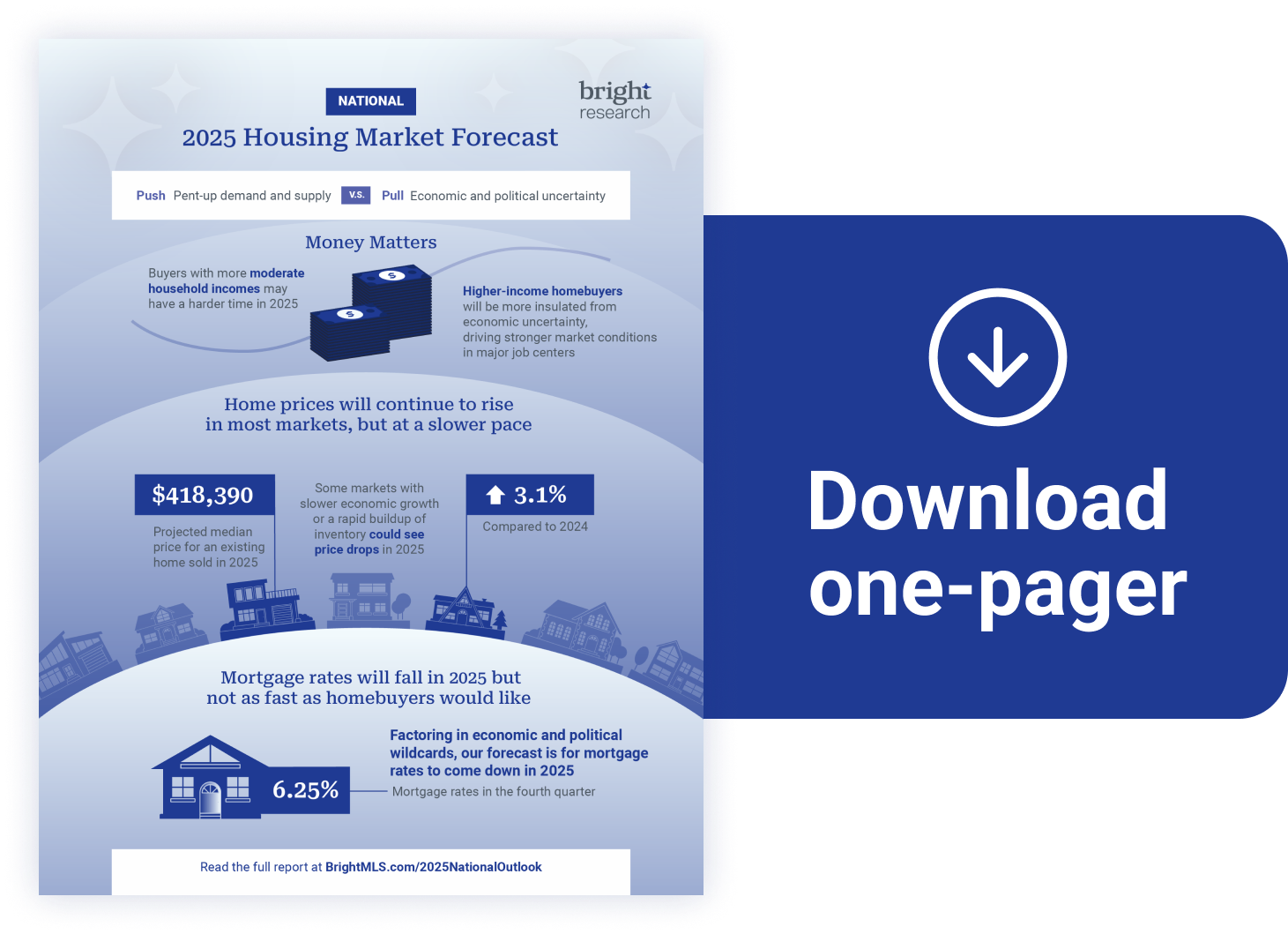
In addition, the housing market could play out in surprising ways in different markets. Markets with lower home prices and more-moderate household incomes may actually be weaker in 2025. Higher-income homebuyers will be more insulated from economic uncertainty and will drive stronger market conditions in major job centers.
Mortgage Rates Will Fall in 2025—But Not As Fast As Homebuyers Would Like
At the end of 2024, mortgage rates are higher and more volatile than we were expecting earlier in the year. So far, the Federal Reserve has cut interest rates twice by a total of 75 basis points; however, mortgage rates have climbed this fall, and in mid-November, the average rate on a 30-year fixed rate mortgage was over 6.8%, the highest level since July. Rates are going to be volatile through the end of the year and into next year as the market responds to fresh economic data and to anticipated policy initiatives from President-elect Trump.
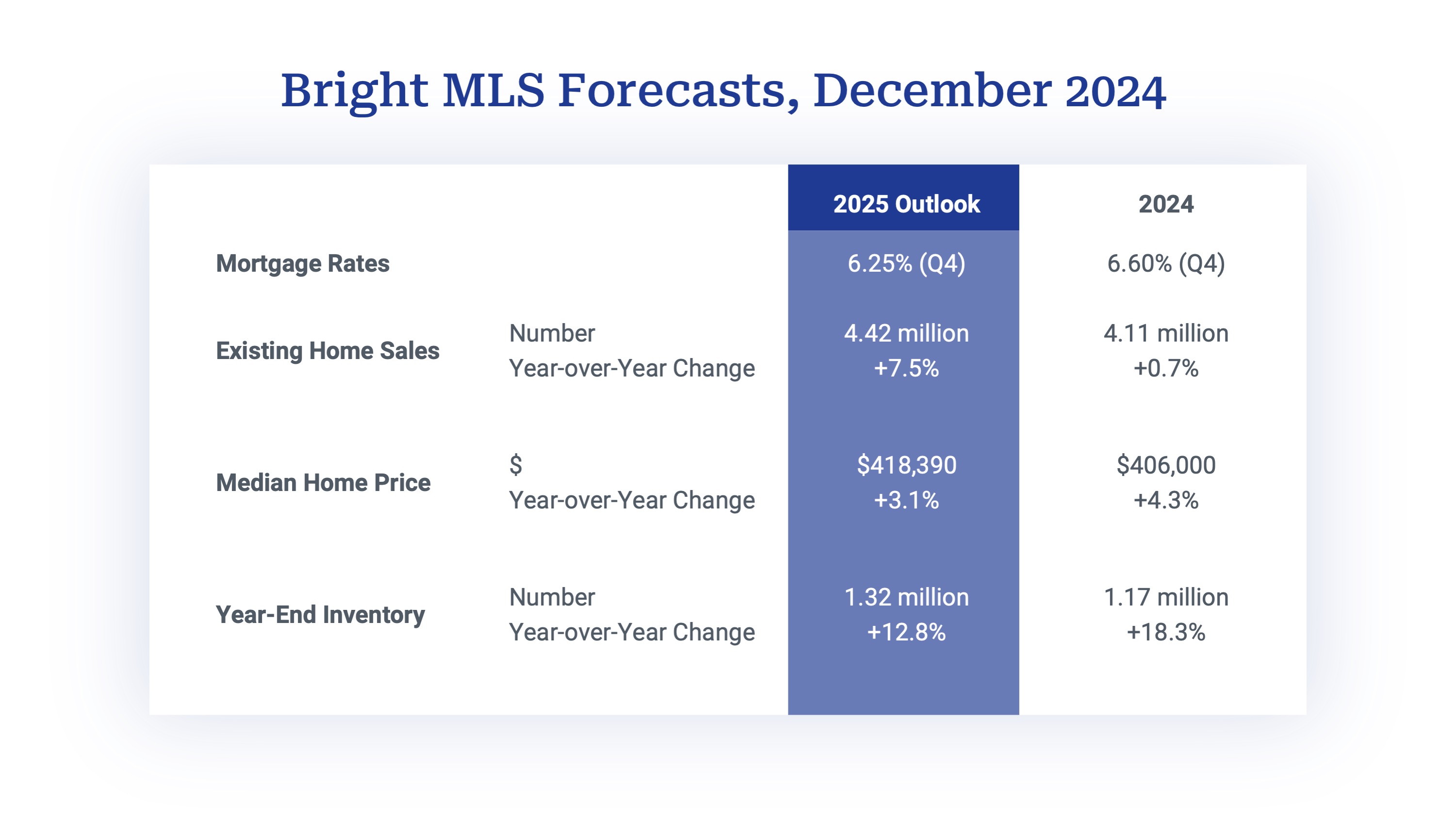
The current forecast is for mortgage rates to average 6.6% in the fourth quarter of 2024. While mortgage rates will fall further in 2025, there are emerging factors that suggest rates will not fall substantially over the next 12 months.
- Under a Trump administration, according to statements by the candidate during the campaign, several initiatives could be enacted in 2025 that also raise the inflation risk, including new tariffs and a substantial crackdown on immigration.
- In addition, fiscal policies proposed by President-elect Trump during the campaign are projected to add significantly to the federal deficit, which is another factor supporting higher interest rates. Yields on Treasury bonds will remain elevated as the government issues more bonds to pay interest on the federal debt. Mortgage rates tend to follow Treasury yields which means that mortgage rates also will remain relatively elevated in 2025.
There are wildcards in the economic and political landscape that could shift interest rates lower in 2025. An economic recession—though unlikely at this point—would be a key reason we could see mortgage rates fall more quickly than projected in 2025.
Sifting through these competing economic factors, our forecast is for mortgage rates to come down in 2025, reaching 6.25% in the fourth quarter of 2025.
Existing Home Sales Up in 2025
Through September, U.S. home sales were running at 97% of 2023 levels. There was an uptick in new pending sales in October, which suggests that the fourth quarter will put 2024 slightly above 2023 in terms of overall sales.
A forecast of 4.1 million home sales in 2024 is 0.7% above 2023 totals. The number of existing home sales transactions in 2024 is still far below the long-term annual average of 5.2 million sales. It is going to be some time before we get back to that long-term average sales total.
In 2025, there are countervailing factors that will influence the number of existing home sales transactions across the U.S.
· There is significant pent-up demand in the housing market, as both prospective first-time homebuyers and repeat buyers have been sitting out as interest rates remained elevated throughout 2024. While mortgage rates are projected to remain well in the 6s through 2025, prospective buyers may not be concerned. Consumers have anchored their expectations and see rates above 6% as the new normal. First-time buyers have been saving money—and more are receiving funds from their Baby Boomer parents—and will see 2025 as the opportunity to get into the market if there is more inventory, softer home price appreciation, and more room for negotiation.
· On the other hand, prospective homebuyers will face some daunting challenges in 2025. High home prices coupled with elevated mortgage rates will price more first-time and moderate-income buyers out of the market in 2025. A healthy supply of rental housing means that in many markets, renting will make more sense than buying. Economic conditions are still relatively strong heading into 2025; however, savings rates have fallen and consumer debt levels are on the rise, which is impacting the financial situations of some individuals and families and could keep them out of the housing market.
Overall, the projection is for there to be 4.423 million existing home sales in 2025, a 7.5% increase over 2024 but still lower than the long-term annual average of 5.2 million sales and about 17% below 2019 existing home sales totals.
The uptick in home sales activity will not occur evenly throughout the U.S. Regions with higher-income households, stronger job growth, and greater affordability will see relatively strong home sales activity. (See Metro discussion.)
Existing Home Inventory Increases More Slowly in 2025
In 2024, there were steady increases in inventory across the country. The number of active listings was on the rise as new pending contract activity slowed while more existing homeowners listed their home for sale. Mortgage “rate lock” has restrained the number of existing homeowners who want to sell, but, over time, family and financial changes have led more people to sell.
At the end of 2024, it is projected that there will be 1.17 million existing homes available for sale in the U.S., an 18.3% increase over 2023.
More sellers are projected to get into the market in 2025. New listings will come from a variety of sources, generally driven by the demographic factors that typically lead people to move—marriage, children, divorce, retirement, and death. At the end of 2024, we saw more second- and investment properties come on the market, and that trend will likely continue in 2025.
At the end of 2025, the total inventory of existing homes for sale is projected to be 1.320 million listings, a 12.8% increase over 2024 but still about 5% lower than what was available on the market at the end of 2019. Inventory will grow more slowly in 2025 than in 2024 primarily because of activity in the new home market. In many places, a slowdown in new residential construction means slower growth in the inventory of existing homes for sale. When there are fewer new homes available on the market, buyers must look at existing homes, which draws down the inventory of those existing homes more quicky.
Home Prices Continue to Rise in Most Markets, But at a Slower Pace
Even amidst high mortgage rates and high home prices, home price growth was strong in 2024. There were two main reasons for continued strong price growth: (1) inventory was still very constrained in most markets and (2) repeat homebuyers had a lot of equity they could roll into the purchase of a new home.
Home price appreciation has been slowing at the end of 2024 as more inventory has come onto the market and as more homebuyers are priced out. For 2024 overall, the median price of an existing home sold in 2024 is projected to be $406,600, which is a 4.3% increase over 2023.
There will be different factors that push and pull home prices in 2025. There are no major risks evident in either the economy or the housing market to suggest a major nationwide drop in home prices. Our projections are for home prices to continue to rise in 2025, although more slowly, with the median price for an existing home sold in 2025 of $418,390, a 3.1% increase over 2024.
Home prices will grow more slowly in 2025 primarily because there will be more inventory on the market and buyers will have a little more leverage. In many markets, buyers have hit an affordability ceiling, which will only improve modestly in 2025 as rates come down. Sellers will have to adjust expectations to attract buyers.
There will be a lot of variation across U.S. markets in terms of home prices in 2025. Markets with higher-income households—even those markets where home prices are already high—are likely to see the fastest price appreciation in 2025. More moderate-income markets will see less upward pressure on prices, as homebuyers in these markets will be more adversely impacted by elevated rates and affordability challenges. (See Metro discussion.)
Home prices by metro
There is a lot of variation in housing markets across the country. In some markets, inventory is expanding quickly, and price growth is slowing or even reversing. Other markets continue to see strong upward pressure on prices, even with elevated mortgage rates.
To predict metro-level home price change, we looked at several factors that will drive home prices. The markets most at risk of slow price growth, or even year-over-year price declines, are those where:
- Inventory gains have been significantly* greater than in other markets
- Regional employment has declined over the past year (as of August)
- Current median home prices are more than 10 times higher than per capita income.
*Significantly more/greater means higher than the national average by 50% or more
However, it is not just about housing market conditions. Higher-income households and homeowners likely will fare better in the 2025 housing market than will entry-level and moderate-income buyers. Metros where overall household incomes are lower are more at risk of a weakening housing market, while higher-income metros—even those where home prices are very high—are projected to see stronger price growth.
This apparent incongruity reflects the fact that higher-income households, including higher-income first-time buyers, are likely to fare better in the 2025 housing market. While first-time buyers have been a smaller share of the homebuying population over the past year, many of those who have been active in the market are getting financial help from their parents, who have been able to tap into significant housing and other wealth. Repeat buyers in higher-cost markets have accumulated significant equity and can more easily roll that equity into the purchase of a new home.
As such, many of the higher-cost metros—including Boston, New York, and Washington, D.C.—are projected to have faster price growth in 2025 than the national average.
Mid-Atlantic Housing Market Outlook
What’s in store for the Bright MLS service area? Get the Mid-Atlantic forecast for 2025.