
NEWS
2026 National Housing Market Outlook
Another transition year for the U.S. housing market: Regional economic and demographic factors drive a divide in 2026

Where will we end 2025?
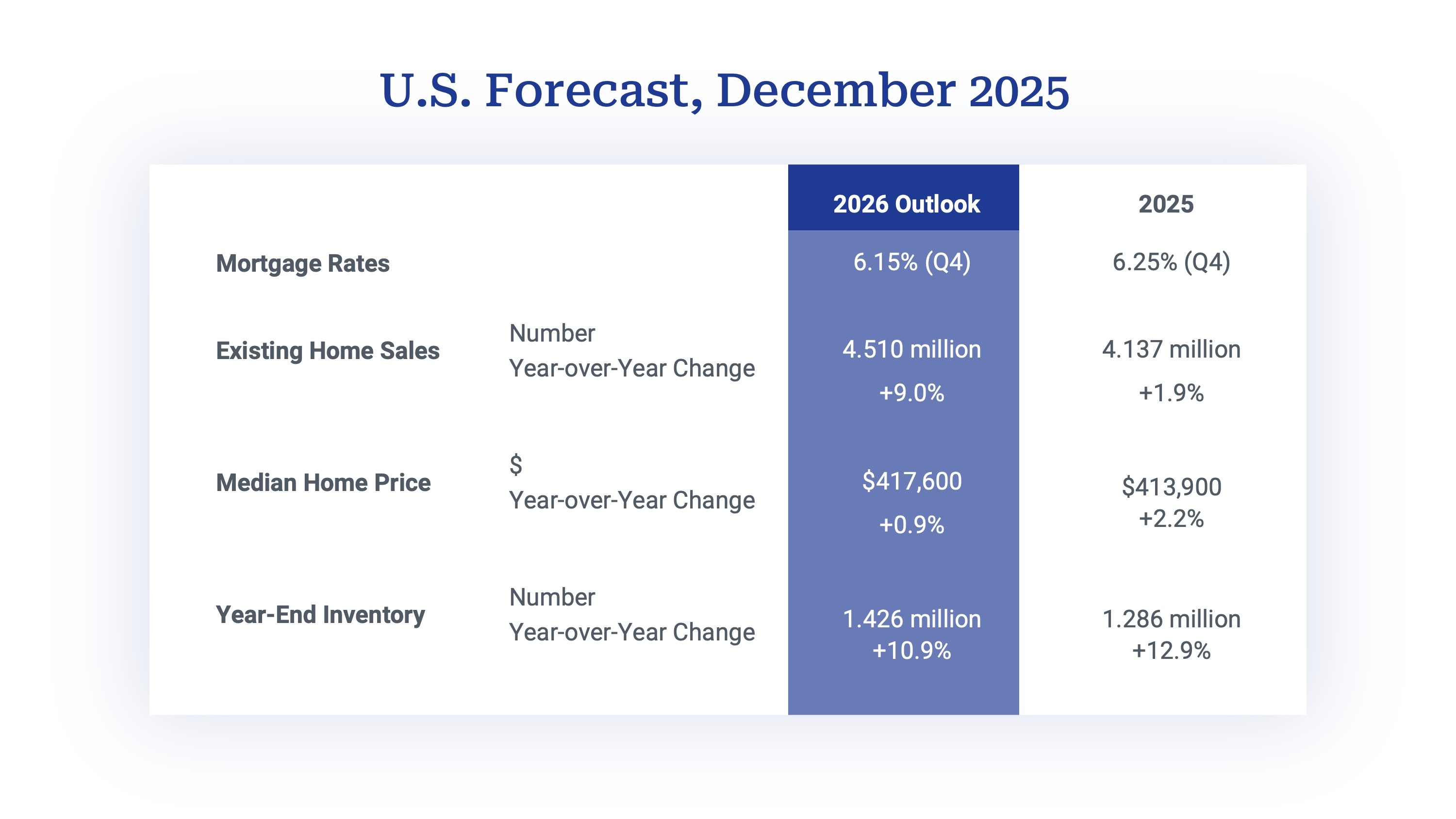
Several factors drove the slower-than-average housing market in 2025, from low inventory and persistently high mortgage rates at the beginning of the year to growing economic uncertainty and consumer anxiety at the end. Bright MLS forecasts indicate that 2025 will end with 4.137 million existing home sales nationally, a 1.9% increase from 2024 but still far below the long-term average of about 5 million sales annually.
Home prices continued to rise in 2025, as higher-income buyers dominated in most markets. The 2025 median price is projected to be $413,900, a 2.2% increase over 2024. Despite a slowdown in home price appreciation, the 2025 median price is still more than 50% higher than it was in 2019.
Inventory increased in 2025, as sellers felt less locked in by their mortgage rates and changing family and financial circumstances led more homeowners to list. At the end of 2025, it is projected that there will be 1.286 million homes available for sale, a 12.9% increase over 2024, but still ending the year with inventory slightly below 2019 levels.
The Outlook for 2026
Next year is expected to be another transition year for the U.S. housing market. There will be factors that will provide both headwinds and tailwinds to the housing market, and there will also be a significant amount of uncertainty in the economy and the market. Regional housing market differences will characterize the 2026 housing market.
Lower rates will improve affordability and bring more buyers into the market in 2026. Mortgage rates began falling at the end of the third quarter of 2025. With additional Federal Reserve rate cuts planned for 2026, a response to weakening economic conditions, expect mortgage rates to fall from about 6.25% at the beginning of 2026 to 6.15% by the end of 2026.
While Fed rate cuts and weaker economic conditions are likely to push rates lower, there are other factors that could work on rates in the other direction. A rise in inflation, an increase in federal deficits growth, or an unexpected international conflict could all lead to upward pressure on rates.
While rates are projected to fall in 2026, the average rate on a 30-year fixed rate mortgage is expected to remain above 6% through the end of 2026.
More home sales in 2026, but transactions still below pre-pandemic levels. There is significant pent-up demand in the market, particularly among younger households. If current homeownership rates for people in their 30s and 40s were the same as they were in 2000, we have an estimated 750,000 more homeowners in the U.S.
It is still going to be a challenging market for first-time buyers, but lower mortgage rates and more inventory will unleash some of that demand in 2026, particularly in the second half of the year. Bright MLS projects that there will be 4.510 million existing home sales in the U.S. in 2026, reflecting a 9.0% increase over 2025.
Home price growth will slow, but price trends will vary significantly across markets. Home price growth will continue to slow into the first quarter of 2026. As more entry-level and first-time buyers enter the market in the second half of the year, the median home prices in some markets will actually be lower than they were in 2025. Bright MLS forecasts are for the median sold price in 2026 to be $417,600 next year, a modest 0.9% gain over 2025.
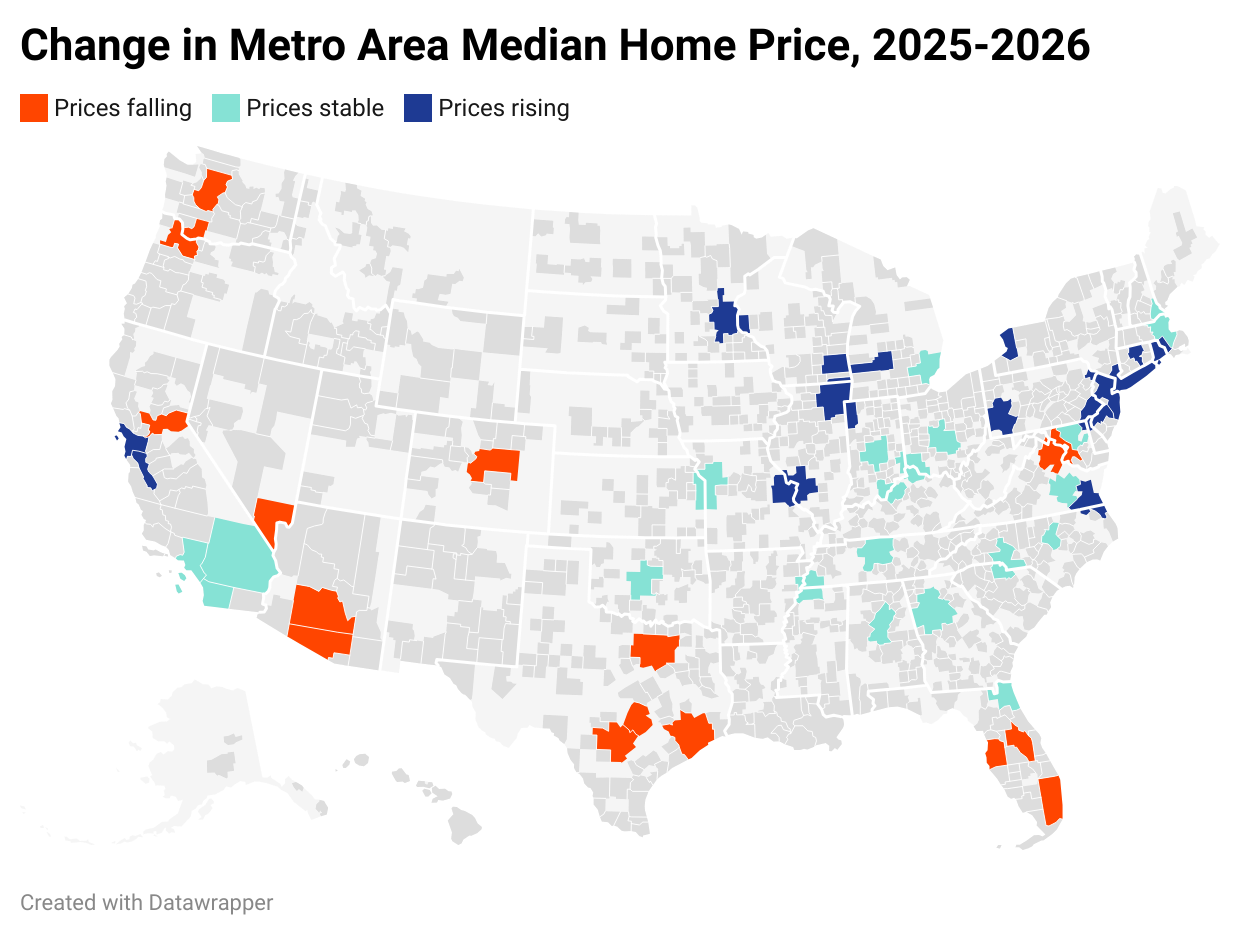
Local economic and housing market conditions heading into 2026 are going to play a big role in home price trends.
Home prices are projected to continue to rise in markets in the Midwest and Northeast, where inventory is still far below pre-pandemic levels, new construction is limited, and prices did not rise as quickly during the pandemic.
Bright MLS forecasts also project home price growth in the high-cost markets of San Jose and San Francisco, fueled by expansion of the AI economy in those markets and the migration of high-income workers.
On the other hand, there are metro area markets where inventory surged in 2025 and where there has been a significant pullback in demand. In none of the 50 largest metro areas is a major price correction predicted; however, in some markets we should expect modest price declines in 2026. In Florida, there has been a pullback in demand at the same time inventory is soaring, setting up some markets such as Tampa, Miami, and Orlando for year-over price declines.
A similar pattern can be seen in metro area markets in Texas, Portland (Ore.), Seattle, and Denver, where inventory exceeds where it was prior to the pandemic and where affordability has become a significant challenge to the regions’ residents.
In the Washington, D.C., metro area, the biggest challenge in the housing market is the uncertainty around federal government employment. In the fourth quarter of 2025, the federal government shut down for 44 days, the longest federal government shutdown in history, leaving many of the region’s 200,000+ federal government workers and more than 400,000 private-sector contracts on edge. Inventory increased faster in the D.C. region than in other Mid-Atlantic markets, and some of that inventory growth was driven by workers, particularly those near retirement, leaving federal government employment and the region. Home prices were propped up in 2025 by luxury buyers, but that segment of the market is likely to be weaker in 2026, putting downward pressure on the overall median price in the D.C. region.
Expect the Unexpected
If we have learned anything from the housing market over the past few years, it is to expect the unexpected and to prepare to be surprised by the market. In that vein, here are the wildcards to watch out for in 2026:
- Privatization of Fannie Mae and Freddie Mac. The Trump administration has floated issuing IPOs for shares in the GSEs, taking a small step toward privatization. The details are still murky, but if this initiative goes through, it would likely send mortgage rates up slightly (+5 to 25 basis points). Some lower-income buyers, including first-time buyers, could be shut out of the market.
The surge in enthusiasm by investors for AI technology and services has raised warning flags of an AI bubble. Should there be such a bubble—and if that bubble should burst—the individuals, households, and regions invested in AI could see a downturn in housing demand.- Higher-end buyers could continue to swamp the market. Higher-income households propped up consumer spending in 2025, but toward the end of the year, there were signs that these higher-income households were pulling back. These forecasts assume that high-end buyers will be less active than they were in 2025 as the growing economic unease moves up the economic ladder. However, if high-income households remain bullish on the economy and the housing market, they could again drive housing market activity and push median prices up, even in markets where affordability is challenging.
Mid-Atlantic Housing Market Outlook
What’s in store for the Bright MLS service area? Get the Mid-Atlantic forecast for 2026.