
Nearly every local market across the Mid-Atlantic saw prices grow in May. Learn more about the ten areas that experienced the fastest price growth.
NEWS
Exploring Metro Area Employment Trends
Where will job growth support a strong housing market in the second half of 2022? Bright MLS Chief Economist Lisa Sturtevant, PhD, explores the employment trends across U.S. metropolitan areas.
With the onset of the pandemic in the spring of 2020, there were significant job losses in every metropolitan area in the U.S. Since then, however, there has been strong job growth across most regions of the country. While some places have been outperformers over the past two years, other metro area economies will be more durable if the national economic picture worsens. Understanding local and regional employment trends is critical for assessing the outlook for the housing market.
According to data from the U.S. Bureau of Labor Statistics, the nation’s top 20 metropolitan areas (as measured by employment) experienced double-digit job growth between May 2020 and May 2022. The Detroit metropolitan area had the fastest growth, with total employment increasing by 26.1% over the past two years. In the mid-Atlantic, the Philadelphia region led, with a 15.7% increase in jobs between May 2020 and May 2021.

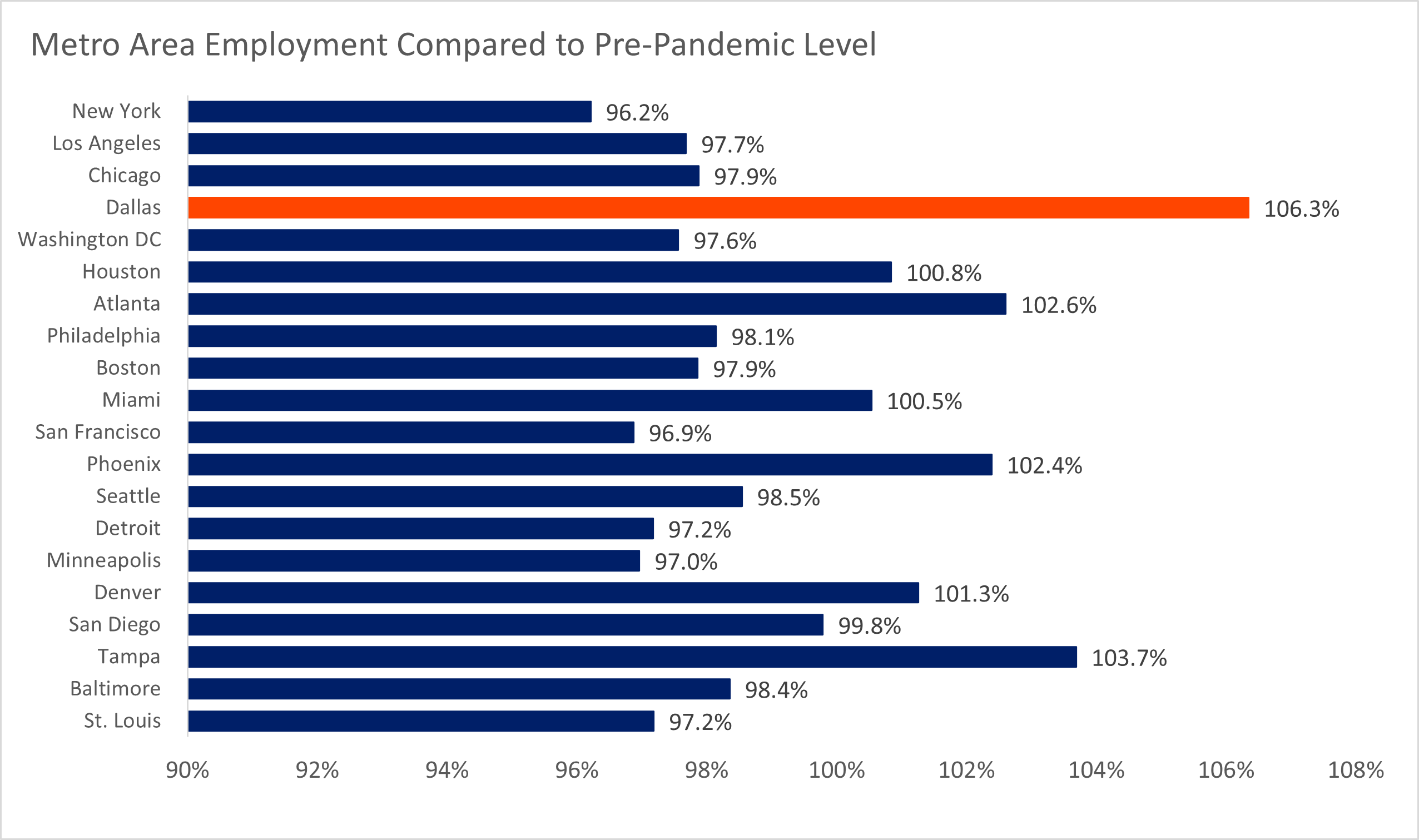
Despite significant gains, employment levels in many metropolitan areas remain below what they were prior to the pandemic. In the Washington DC, Baltimore, and Philadelphia metro areas, current employment levels are at about 98% of pre-pandemic levels. However, there are some regions where job totals surpassed pre-pandemic levels. In the Dallas metro area, employment is now 6.5% higher than it was before the pandemic. Employment is back to pre-pandemic levels in Houston, Atlanta, Miami, Phoenix, Denver, and Tampa, as well.
Strong job growth is important for a robust housing market. However, it is not just about the number of jobs but also the types of jobs. The mix of jobs in a region is particularly important if overall economic conditions weaken or if we enter into a formal economic recession. Some industries tend to be more insulated from economic downturns and would perform better than others if overall economic growth slowed. The professional and technical services, health care, and government sectors all tend to be more “recession-resistant” than other economic sectors. These are industries that tend to include higher-wage, professional employees, and where there usually are fewer cutbacks during economic slowdowns.
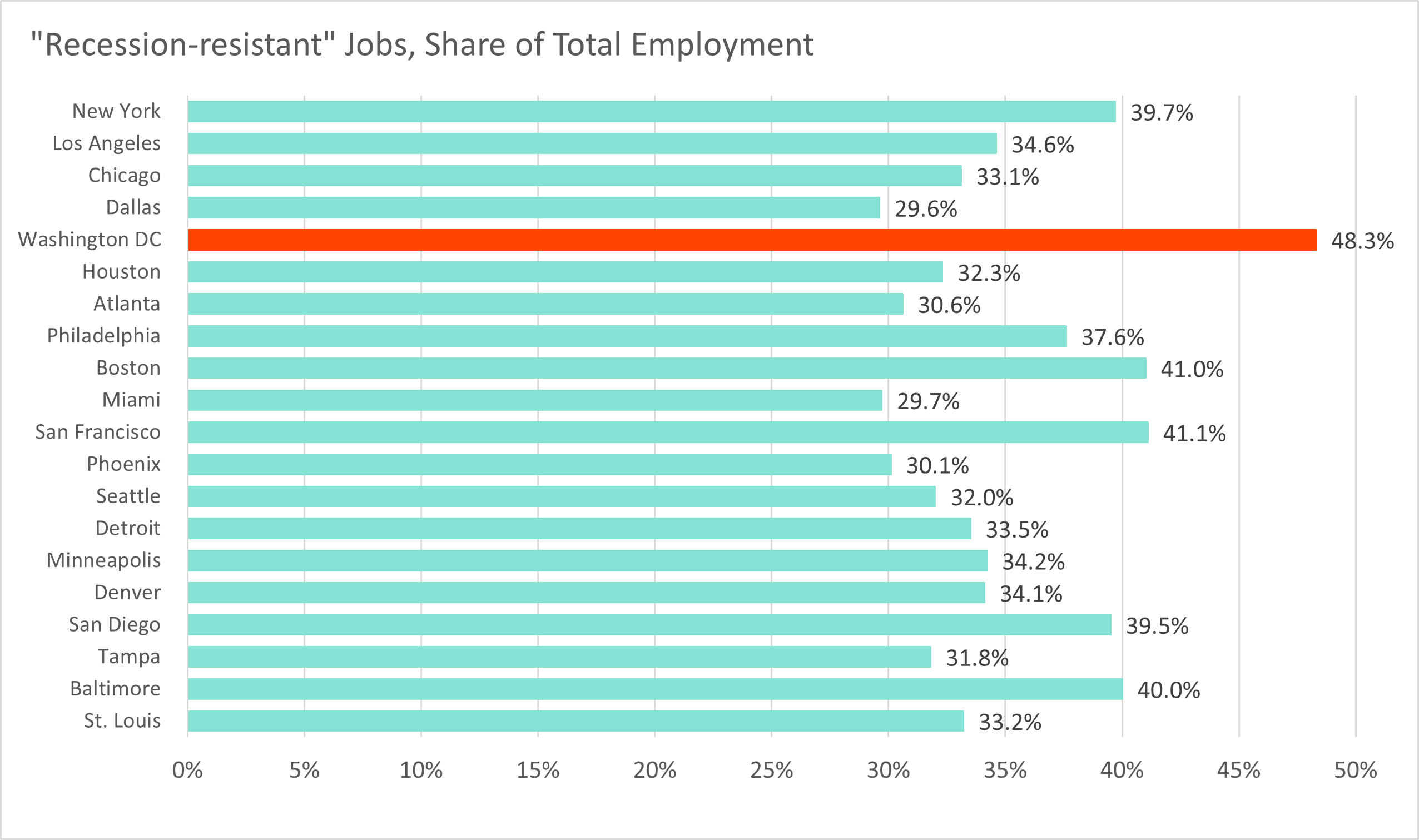
There is a lot of variation across metro areas in the share of so-called “recession-resistant” jobs. The Washington DC metropolitan area has the largest share (48.3%), driven by the large government sector, as well as the associated professional and technical services sector that supports Federal government activities. The high-share of “recession-resistant” jobs in Boston and San Francisco are driven primarily by the technology sector.
In the Philadelphia metro area, an estimated 37.6% of jobs are in of these three “recession-resistant” sectors, with health care as the key sector (17.9% of all jobs). In Baltimore, the share is 40.0%, with relatively strong health care and government sectors.
Economic conditions have improved considerably over the past two years, but uncertainty remains. High inflation, rising interest rates, shaky stock market conditions, and on-going global challenges have raised the risks of a recession in the next 12 months. An economic recession would slow housing market activity further, but the impacts will be different from place to place, with some regions more insulated than others from a prospective downturn. Metropolitan areas with high shares of jobs in the professional and technical services, health care, and government sectors will have steadier housing markets than those with higher concentrations of jobs in other sectors, such as retail, leisure and hospitality, or manufacturing.
To stay informed about housing market conditions, be sure to make use of Bright’s housing market reports and get a preview of future buyer activity by tracking the Bright MLS T3 Home Demand Index for the Philadelphia, Baltimore, and Washington DC regions.

Dr. Lisa Sturtevant serves Bright MLS as the nation’s only MLS-focused economist. She leads research, reporting and insights from Bright’s comprehensive array of real estate data. In 2021, Bright’s over 100,000 subscribers facilitated $142B in real estate transactions through its system stretching across 6 states and the District of Columbia.
Get Answers from Our Expert
Have questions about the current housing market you'd like Bright's Economist, Lisa Sturtevant, to address in an upcoming article? Let us know!
Recent articles
Jump in rates has led to a 44% increase in monthly mortgage payments in the mid-Atlantic.
Back to Top