
Results from a new survey show consumers blame low incomes, high mortgage rates for current affordability constraints.
NEWS
Housing Affordability in the Mid-Atlantic Region
Rising home prices and elevated mortgage rates have led to significant housing affordability challenges in the Mid-Atlantic housing market.
Between 2020 and 2025, the median sold price in the Bright MLS service area has increased by 35%. However, as mortgage rates surged beginning in 2022, the monthly payment on the median-priced home has increased by more than 70% over the past five years. (The Bright MLS area covers six states and the District of Columbia.)
There are very few markets where the median-income household can afford the median-priced home
In the fourth quarter of 2025, across the 90-county Bright MLS service area, there were only six counties where the median-income household could afford the median-priced home. Affordability is determined by comparing the median household income with the income needed to qualify to purchase the median-priced home assuming a 10% down payment, the average mortgage rate for the quarter, a 30-year fixed rate mortgage, and average property tax and homeowners’ insurance payments.
Among the six affordable counties, half are in central Pennsylvania: Juniata County, Mifflin County, and Schuylkill County. Delaware County, outside of Philadelphia, is also a market where the median-priced home is affordable to the median-income household. Alleghany County in western Maryland and the City of Baltimore are also affordable homeownership markets.
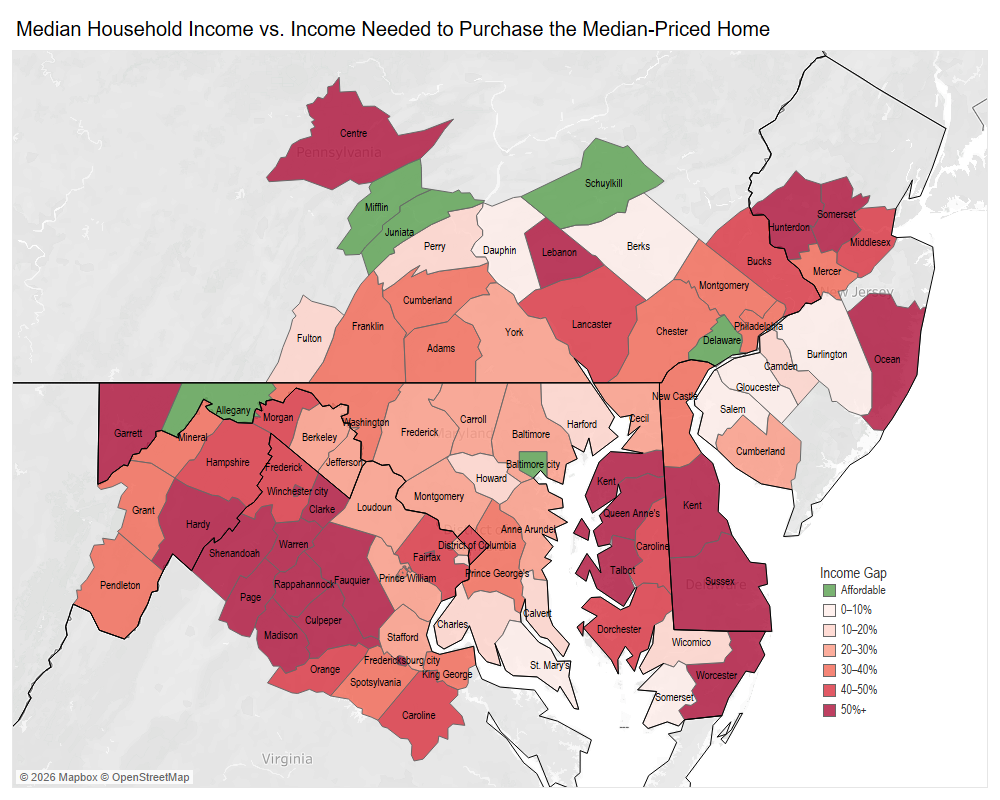
In some local markets in the Mid-Atlantic, the gap between the median household income and the income needed to qualify for the median-priced home is significant. For example, in the cities of Fredericksburg and Falls Church in Virginia, the income needed to qualify is nearly double the current median household income. And there are dozens of other counties where the income gap is greater than 50%, meaning that the typical household would need a 50% or higher raise to afford the median-priced home.
Renters are essentially priced out of the market, with even starter homes unaffordable
For this analysis, a starter home is defined as a home priced at the 35th percentile, meaning a level where 35% of the homes are priced below and 65% are priced above. In the fourth quarter of 2025, the median home price in the Bright MLS service area was $417,500, while the home at the 35th percentile was listed at $340,000.
Comparing median renter incomes to the income needed to qualify to purchase a starter home shows that there is no county in the Bright MLS service area where the median-income renter could afford to buy a starter home.

In about two-thirds of the counties in the Bright MLS service area, the median renter income is less than half of what is needed to qualify to purchase a home priced at the 35th percentile. This means renters would need to see a doubling of their income to be able to qualify to purchase a starter home. Even in the most affordable markets, the income gap for renters is still between 40% and 50%.
Affordability improvements ahead?
Even with these sobering numbers, there are reasons to be cautiously optimistic about future affordability. Lower mortgage rates and slower price growth are helping to ease affordability, which will put homeownership within reach for some households.
It is clear that the affordability gaps are substantial, which means that the focus of policymakers needs to be on ways to increase supply and remove barriers that are keeping would-be buyers on the sidelines.
The path back to a more balanced market will be gradual, but the combination of steady income growth, increasing supply, and lower borrowing costs will make homeownership more attainable in the years ahead.
Exclusive Market Research & Analysis
Get the latest research and studies from Bright at BrightMLS.com/Research.
Recent articles
Consumers are feeling anxious at the start of the year, according to Bright’s recent nationwide consumer survey.
Back to Top