
Rising home prices and elevated mortgage rates have led to significant housing affordability challenges in the Mid-Atlantic housing market.
NEWS
Price Cuts Become More Common as Housing Market Shifts
Sellers of lower-priced homes need the most support for better pricing.
How the Trend Is Shifting
Expanding inventory has shifted the dynamic for sellers in the Mid-Atlantic market. While sellers have had the upper hand for many years, more are needing to cut their asking price to better align with market realities. Roughly a third of sellers (33.7%) who closed in February 2026 had to decrease their list price, and 38.1% of January sellers cut prices. The percentage of closed sales with a price cut was higher in 2025 than 2024, and the first two months of 2026 point to the share remaining above the recent past.
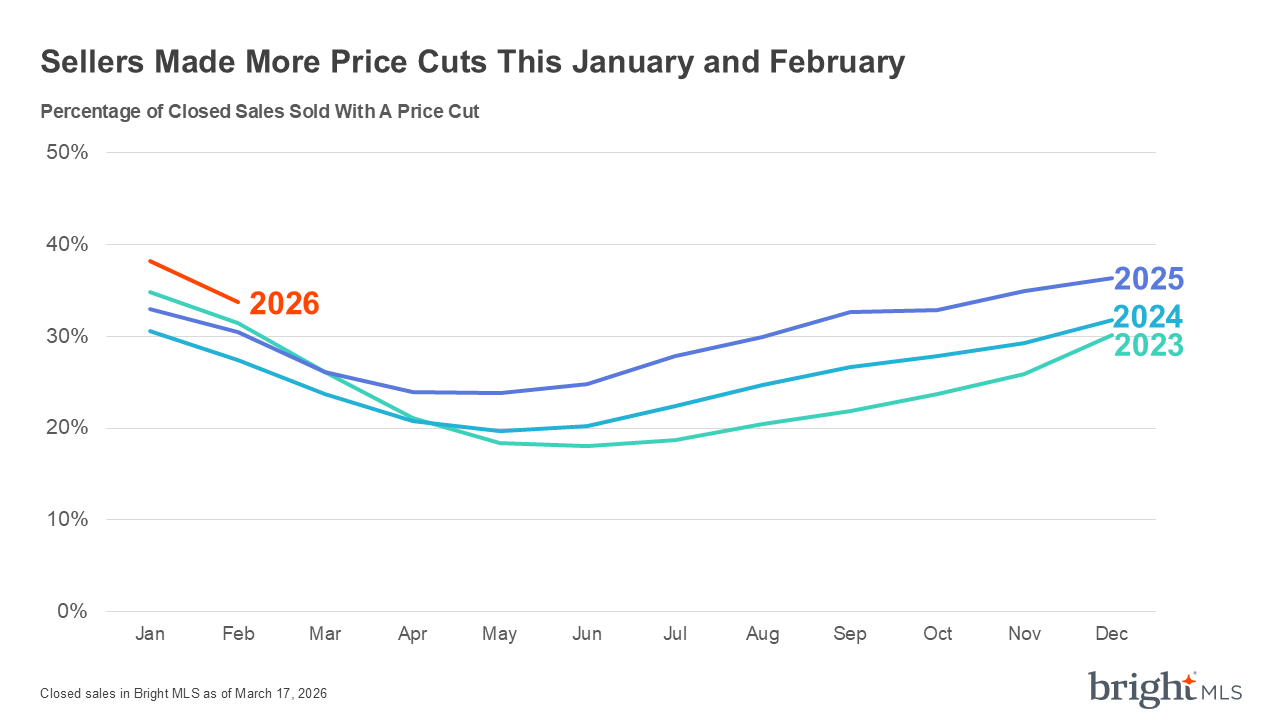
Price cuts tend to follow a seasonal pattern, with the highest share happening in the less active winter months. As the spring market begins to bloom, the share of closed sales requiring a drop in the list price decreases.
All Price Cuts Aren’t Equal
Sellers of lower-priced homes are more likely to cut their asking price. In 37.9% of transactions priced under $300,000, sellers dropped their list price. Moving toward the higher end of the market, the percentage declines. Only 28.6% of closed sales priced over $1 million reduced their list price. However, across all price points, price adjustments are more common this year than last year.
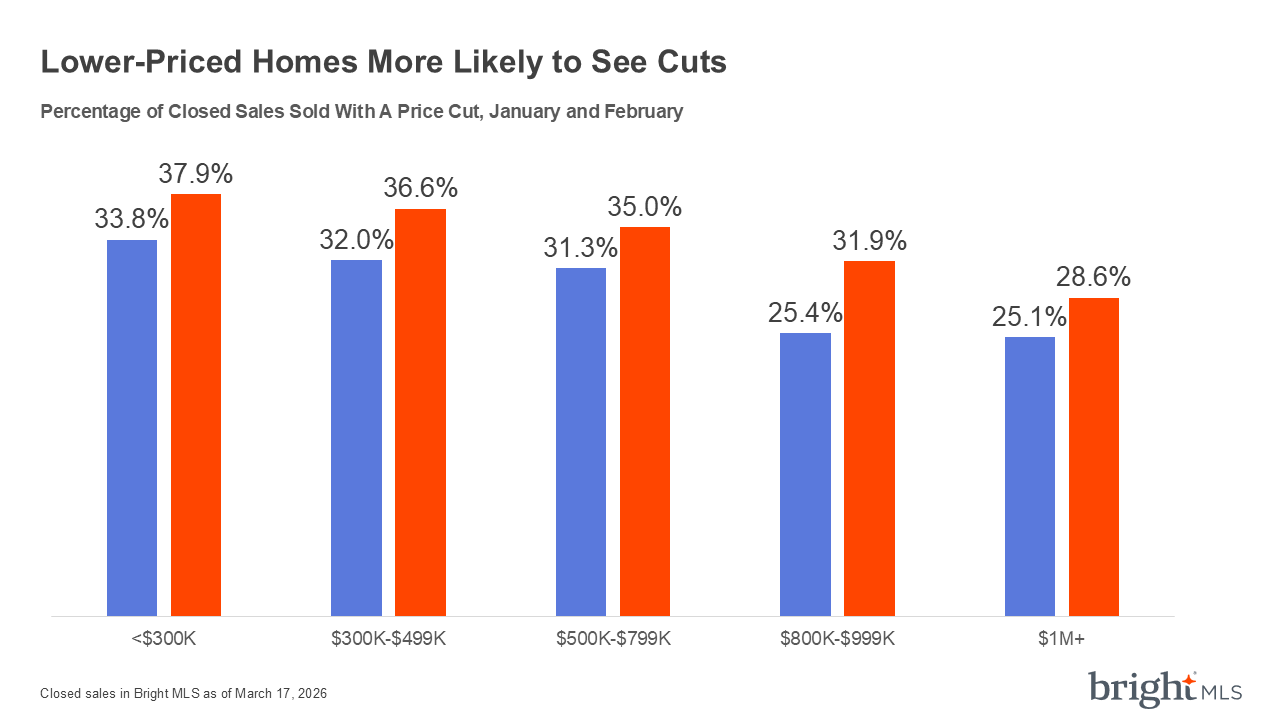
Yet both the lowest and the highest ends of the market tend to need the most tweaking. The magnitude of the cut made by sellers in January and February was 10.0% if the listing was priced under $300,000. Sellers with homes priced above $1 million cut their list price by 7.4%. By comparison, properties priced between $500,000 and $799,999 cut their list price by 5.3%. To put this in dollar perspective, the typical change in ask price for homes under $300,000 was about $22,000; for homes priced higher than $1 million, sellers cut their list price by nearly $170,000 on average.
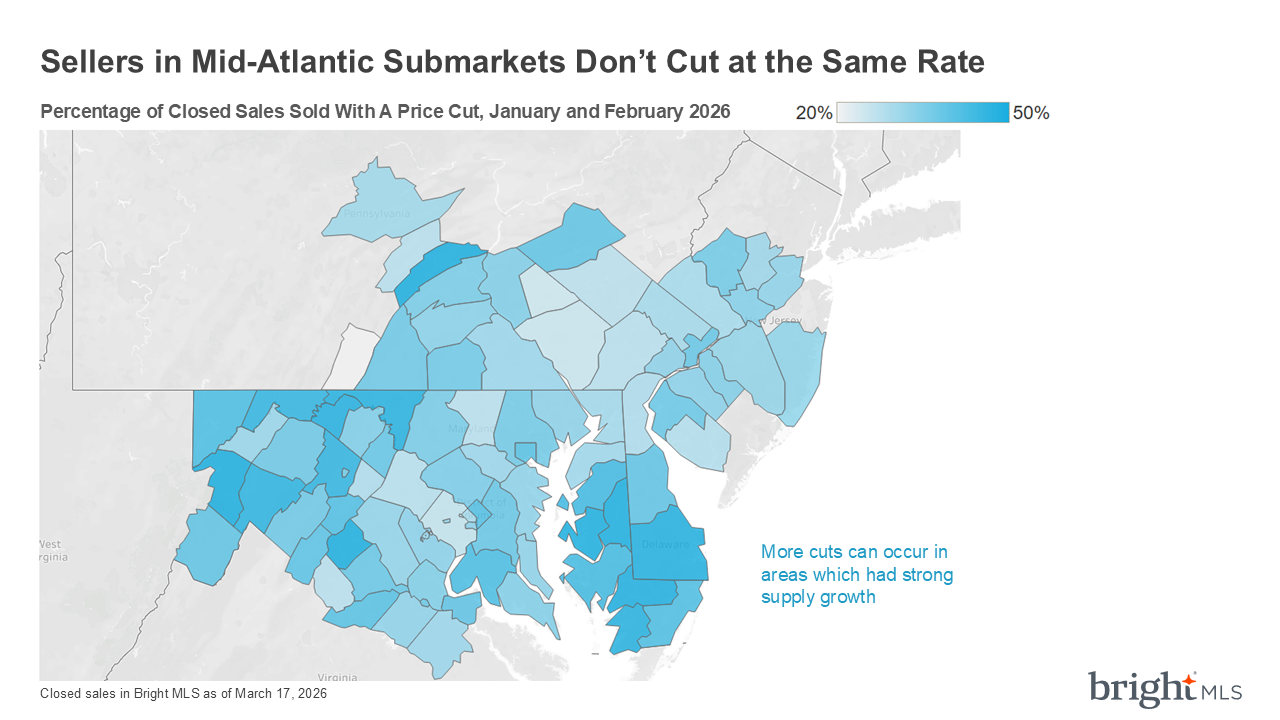
There’s geographical variation among the number of sellers dropping their asking price. Areas with robust active listings growth like Del/Mar Coastal tend to have more closed sales with price cuts. While 2025 inventory gains were similar to other regions, faster growth in past years puts Del/Mar inventory the closest to 2019 levels compared to metros with still restricted supply. The counties with the fewest price cuts in January and February 2026 are Lebanon County, PA (24.9%), Lancaster County, PA (25.4%), and Fairfax County, VA (26.3%).
Each of the home type categories, detached single-family homes, attached townhomes, and condos are more likely to cut their price today than a year ago. While similar, townhomes had the smallest percentage, with a price cut at 35.1%, followed by single-family homes at 36.0% and condos with the most at 37.2%.
The good news: More than half of closed sales in January and February 2026 with a price cut only needed to cut once to attract a buyer. These sellers adjusted their list price by only 4.4%. On the other hand, when sellers cut their asking price three times, the final list price was down by 10%, on average, compared to the original list price. Sales with five or more cuts decreased their price by 15%.
Sellers who only need a single cut are on the market about two months. Those cutting more often typically wait between cuts and should anticipate a longer time on the market. Sellers who made two cuts were listed for over three months, and homes with five or more price cuts stayed on the market for half the year. Decreasing the home’s price when it is on the market can cause seller fatigue and could indicate to buyers that something is “wrong” with the property.
The Final Cut
While price cuts have become more commonplace in the Mid-Atlantic, it is not an inevitability, and the majority of closed sales do not need to adjust their list price. More than half of January and February 2026 closed sales received 98% of their original list price. Further, over a quarter of these sales closed for a price higher than the original list price. Real estate professionals can guide sellers to a proper list price and lead to quicker and sometimes more financially advantageous sales.
Stay tuned for upcoming blogs exploring price cut trends for active listings, whether price cuts impact appointment bookings, and more.
Exclusive Market Research & Analysis
Get the latest research and studies from Bright at BrightMLS.com/Research.
Recent articles
Results from a new survey show consumers blame low incomes, high mortgage rates for current affordability constraints.
Back to Top